Official submissions
COPOUT 613 regularly submits written delegations to Ottawa Police Service Board (OPSB) meetings, which OPSB members studiously ignore. Since OPSB neglects to attach written delegations to the minutes of their meetings (or even mention that there were any written delegations at all), we will be publishing them here.
November 2, 2026: OPSB regular meeting
This submission will address the recommendations from the Ottawa Police Service Board (OPSB) Policy and Governance (P&G) committee related to the Inspectorate of Policing's (IoP) first ever Notice of Issue (NoI): The Increase in Antisemitism and Hate-Motivated Incidents, agenda item number 8.14 1. We will provide comments on both the NoI as well as the Executive Director's (ED) report. COPOUT 613 will provide comments on the four proposed P&G recommendations as well as enhancements to make them broader and more fulsome.
Summary
The Inspector General of Policing and the Ottawa Police Service Board's Policy and Governance Committee have missed the mark. Antisemitism exists in our communities. But there are other hate crimes that go under-reported due to community mistrust in policing that have been ignored by the Notice of Issue and the OPSB response. Those communities deserve a voice and solutions. In addressing the case for combating antisemitic hate crimes, the IoP and OPSB ignore the most prevalent source, fascism and the far right, and instead focus on protests. OPSB's response is disproportionate to how other police boards in Ontario are addressing the NoI. The OPSB recommendations are ill-conceived and require considerable reworking. COPOUT 613 has provided suggested improvements. We call on the IoP to retract the NoI. COPOUT 613 continues to call for openness and transparency from OPSB.
Analysis
As would be expected from police “oversight” organizations, the IoP and OPSB have emphasized policing as a response to hate. COPOUT 613 believes that non-police responses should be considered. This will require broader public consultation. The IoP isn't mandating any change in Ottawa Police Service (OPS) practices, nor is the province providing any new funding in connection with the NoI. Instead, the NoI "contains actions that police services and boards are strongly encouraged [emphasis added] to take."
COPOUT 613 would like to know why the Inspector General of Policing chose to perform his “monitoring and advisory duty” by focusing on antisemitism instead of other issues that could “negatively impact community safety” such as femicide, cybercrime, impaired driving, or any number of other serious crimes. In Ontario there were 47 confirmed femicides in 2024/2025 and over 1,100 since 1990. Those are murders. Statistics Canada reports 16,067 cybercrimes so far this year for Ontario. While Ontario recorded the lowest rate of impaired driving of all provinces in 2023, at 103 per 100,000, it also has the largest population, and therefore many thousands of instances of impaired driving. Is the IoP's choice to focus on antisemitism rather than these other issues a case of engaging in lawfare?
There is antisemitism in our communities. Both the NoI and the ED's report cite examples. Islamophobia is also present in Ottawa and is widespread across Ontario. There is anti-Black, anti-Asian, and anti-Indigenous racism in our community from one end of the province to the other. There's homophobia. Statistics from reputable sources lay out the case for combating all forms of hatred against all groups in our communities.
Some communities are more likely to report hate crimes than others. That doesn't mean that the latter experience fewer hate crimes; it reflects less willingness to report those hate crimes that occur. There are many reasons why some communities might be less inclined to report incidents. As Statistics Canada explains,
Police-reported hate crime information reflects only incidents that come to the attention of police and are subsequently classified as confirmed or suspected hate-motivated crimes. Reporting can be influenced by many factors, including world events, social movements, community awareness, and the expertise of local police. Victims' decisions to report may also be influenced—in terms of their likelihood to report a crime to police—by factors like language barriers, trust in police and the justice system, and fears of stigmatization or further victimization.
In issuing this NoI, the IoP fails to recognize that fact, and continues to marginalize those communities that are already less likely to report hate crimes to police. The OPSB response accentuates that position.
The Canadian Race Relations Foundation (CRRF), a federal Crown corporation mandated to raise public awareness of the causes and manifestations of racism in Canada, provide reasons why some communities don't report hate crimes in their Reporting Hate and Finding Support Toolkit. Among those reasons they list the affected communities' “[m]istrust, distrust, and historically negative relationships with police,” as well as “[b]eing misunderstood, not believed, and marginalized by others, in particular by law enforcement authorities they need to turn to for help.”
Given that there's no basis for the Notice of Issue in the Community Safety and Policing Act (CSPA) and that this was the first ever NoI released by the IoP, it would have been prudent for the IoP to gather a wide selection of communities who experience hate crimes to ask for their views on:
- whether an NoI would be helpful
- how it might work
- which segment of the population should be addressed first or whether the NoI should be more holistic
- whether there are other non-police methods to achieve the same objective.
With the rise in Islamophobic hate crimes across the country, perhaps that form of hate should have been addressed first. Or, with systemic anti-Black racism prevalent not only in the broader society but deeply ingrained in the policing system, as shown, for example, in use of force statistics, perhaps that should have been the candidate for the first NoI. Perhaps the IoP could have suggested more non-police methods to combat hate. We will never know, since the IoP didn't have participants from those groups at its closed-door session and took a very narrow view.
There are no progressive Jewish organizations included in the list of participants at the closed-door meeting held by the IoP on June 15, 2026. For example, Independent Jewish Voices (IJV), the largest of the progressive Jewish groups, was not present. IJV more likely than not would have challenged some of the assumptions put forward, such as the use of the International Holocaust Remembrance Alliance (IHRA) "definition" of antisemitism. But we don't know, since their opinions were not sought by the IoP. The IoP and the groups present in June rely heavily on the IHRA definition of antisemitism, which has been widely criticized because of its use to stifle legitimate criticism of the State of Israel, which defenders of that state refer to as “contemporary antisemitism.” While the Government of Ontario adopted the IHRA definition via an Order in Council in October 2020, it does not alter any laws of the province. Deputy Attorney General (DAG) David Corbett, who is still DAG, said at the time that "[i]t does not otherwise alter any legal definition of antisemitism that may be set out in existing or future laws of Ontario, nor does it direct or require that entities that operate independent of the government adopt that same definition."
A COPOUT 613 ally has obtained and reviewed the material presented at the NoI session in June. Those materials have been withheld by the IoP via the Solicitor General of Ontario (SolGen). Access to information request deadlines have been ignored by the SolGen. Nonetheless, it's highly probable that OPSB has copies of the materials, but also hasn't released them to the public. However, at least one other police service board in Ontario has posted some of the materials on their website. While the IoP advises that other groups might benefit from the NoI, only two instances of specific “others” are mentioned in the 81 pages of materials used during the closed-door session. The only mention of these other groups is to quote statistics on the number of hate crimes reported by members of these communities. In the materials reviewed by COPOUT 613, the IoP devoted much of its time, research, and precious space for this first-ever NoI to hatred directed at one specific segment of society, while devoting little to no analysis and direction to combating any other forms of hatred.
COPOUT 613's search of major police boards from across Ontario has shown that OPSB is an outlier when it comes to how it's addressing this NoI. Some boards have made no public acknowledgement whatsoever of the NoI. Others have accepted the NoI for information purposes. Yet others have simply passed it along to their chiefs of police for an assessment. The OPSB's P&G committee, for some reason, has the belief that this NoI requires policy re-writes, an increase in the OPS budget, new Key Performance Indicators on how the Chief is combating antisemitism, and specialized training for OPSB members to identify “contemporary antisemitism,” as well as delving into the ongoing operations of OPS.
The materials presented at the closed-door NoI session in June are heavily focused on the IHRA definition. That definition identifies any criticism of the State of Israel as antisemitic. COPOUT 613 can only conclude that the OPSB in camera training will focus on Palestinian anti-genocide protests as the root of antisemitism. If that's the case, then OPSB, under the guise of combating hate, will itself be engaged in hate, namely, against Palestinians.
An April 2022 framework developed by the Arab Canadian Lawyers Association defines anti-Palestinian racism (APR) as “a form of anti-Arab racism that silences, excludes, erases, stereotypes, defames or dehumanizes Palestinians or their narratives. Its manifestations include denying the Nakba, justifying violence against Palestinians, excluding Palestinian perspectives, and portraying Palestinians and their allies as inherently antisemitic or as terrorist threats or sympathizers.” Anti-Palestinian racism has now been recognized by the Province of Manitoba. The NoI makes no mention of anti-Palestinian hatred, even though it is prevalent and systemic.
We remind the members of OPSB that at the September 29, 2025 OPSB meeting, City Councillor David Hill, speaking as a public delegate, accused those protesting the Canadian government's support for the genocidal actions of the State of Israel of being antisemitic under the guise of anti-Zionism. In essence, David Hill accused every person who exercises their Charter-protected right to peacefully protest a genocide and support their Palestinian neighbours of being antisemitic. This is a classic instance of APR under the definition cited above. No member of OPSB challenged this delegation or voiced any opposition to the racism it expressed, even after a member of the public called-out the Hill remarks at the next OPSB meeting.
Within both the NoI and the ED's report, references are made to “protests” as prime vectors for hate speech. Conversely, neither the NoI nor the ED's report make any reference whatsoever to fascism as a prime vector for antisemitism. A case in point is the Dominion Society of Canada, which has been postering and stickering all corners of Ottawa with a QR code to obtain more information on “fixing” Canada's problems, including banning the sale of halal and kosher meats. The ED's report specifically mentions the horrific incident that happened at the synagogue in Belleville, but failed to clearly state that the perpetrator had fascist leanings and had no connection to any progressive protest movement. Furthermore, the ED implies that the vandalism of the Holocaust memorial, which took place in July 2025, was a hate crime. Yet according to the trial judge it was not. Instead, while it certainly caused harm to the community, the incident constituted a plea for help for the victims of genocide by a person who believed he had no other way to express his frustration.
At the October 2, 2026 Policy and Governance Committee meeting, in answer to a question from Member Curry related to the drop in hate crime reporting in 2025, Chief Stubbs indicated that in the first 2 years after the Hamas attack on Israel and the subsequent rise in protests, there was a spike in reports of “hate crimes.” He went on to further clarify that since there have been fewer protests, the number of hate crime reports and therefore investigations have dropped. To COPOUT 613's knowledge, no one has been charged or convicted in any of these “hate crimes” related to protests. It should be noted that the October 2, 2026 P&G meeting minutes are extremely disingenuous in the attribution of Chief Stubb's comments on hate crimes and protests. The minutes say "intensity of hate crime activity had declined over the past year, alongside a decrease in the number of protests." The chief never said that "hate crime activity had declined". He said "hate crime reports" had declined. There's a big difference between a "report" of hate crime and the actual hate crime "activity". One implies that someone believes there was a hate crime: A report. The other implies that OPS believe there were hate crimes: An activity. It's these continuous misrepresentations of facts that give reason for the community's lack of strust in how the OPSB operates.
The Toronto Police Service (TPS) 2024 Hate Crime report says that “[t]here is a notable correlation between geopolitical events and increased hate crime reporting.” It goes on to say:
In 2024, hate crime occurrences peaked in May and June. This time frame correlates to the rise of international and local student protests that included encampments at universities/colleges. These events may have drawn increased community awareness, media attention, and vigilance around hate crime reporting, contributing to the peak seen in these two months. Occurrences have gradually declined since this time as these activities diminished. These student protest activities are not believed to have caused the increase in hate crime offences.
While TPS doesn't explicitly say so, one can conclude that because some felt “uncomfortable” with the subject of the protests, they perceived that they were being “threatened,” i.e., that the protests were a “hate crime.”
The TPS report goes on to say:
As in previous years the most commonly reported hate motivated offences in 2024 were mischief-related, many of these instances of graffiti.
The most common location type in reported occurrences were public streets and roads, with a quarter of all hate crimes occurring at these locations. These are publicly accessible areas, meaning high pedestrian traffic and greater visibility for graffiti and vandalism messaging.
Many offences are committed without a victim present, few or no witnesses, and little forensic or digital evidence. Despite these challenges, the H.C.U. (Hate Crimes Unit) conducts substantial video canvassing and releases numerous bulletins in an effort to identify suspects.
In 2024, 115 individuals were charged with hate motivated criminal offences. The majority were adult males, most commonly between the ages of 26 and 40.
To summarize the TPS report, these are not hate crimes committed at protests. These are young males writing graffiti when there's no one else around. Why then are the NoI and the ED report focusing on protests as prime vectors for hate crimes?
While the NoI, the ED report, and the verbal comments by Chief Stubbs imply that protests are a driver of hate crimes, the data don't generally support that view. For example, in 2025, close to a quarter of the reports of hate crimes against the Jewish community were related to one instance of fascist leaflets being distributed to some homes in Osgoode in June 2025. There are statistics, and then there are the stories behind the statistics.
COPOUT 613 response to recommendations
In response to the NoI, there are four recommendations submitted by the ED in his report to the committee. However, COPOUT 613 recommends that, as other police boards have done in Ontario, the OPSB should simply thank the IoP for the notice and indicate that they will remain vigilant in addressing all forms of hate.
Otherwise, if the OPSB insists on going forward, here are our improvements to the proposed recommendations, as amended at the Policy and Governance Committee meeting on October 2, 2026, to give a holistic approach:
-
Policy and Governance Committee recommendation: “Direct the Executive Director to ensure that the consultations undertaken in 2027 for the development of the Board’s next Strategic Plan expressly address hate-motivated crimes and incidents, including antisemitism, and seek the perspectives of Jewish communities and other communities affected by hate in Ottawa.”
✅COPOUT 613 recommends that OPSB:
- invite national representatives of progressive Jewish organizations such as IJV, as well as local Ottawa progressive Jewish voices, to participate in this consultation to make up for the IoP's flagrant disregard for their views at the June 15, 2026 meeting.
- use the existing Community Equity Council as a forum to conduct consultations, since the goal of the exercise is to combat hate speech against all groups.
- invite a broad swath of groups from many other sectors of society who can provide community-specific advice and lived experience such as the Black, Asian, Muslim, Indigeneous, and LGBTQ+ communities.
-
Policy and Governance Committee recommendation: “Direct the Chief of Police to provide a report to the Board, through the Policy and Governance Committee, on the mandate, capacity and operations of the Hate and Bias Crime Unit, current Service practices in relation to each of the seven actions identified in the Notice of Issue, and actions underway or planned.”
✅COPOUT 613 response to OPSB:
COPOUT 613 finds it curious that the OPSB is choosing in this circumstance to become involved in OPS operations. We advise that much more community consultation is required before embarking on such an over-the-top approach. Member Curry at the committee asked how much this will cost and if other levels of government could pay. Does OPSB ask those questions with respect to all OPS programs? How much and when is it acceptable for OPSB to get involved in operations? COPOUT 613 believes there needs to be much more oversight of OPS, not just in selective cases. COPOUT 613 asks for transparency if/when these discussions happen.
-
Policy and Governance Committee recommendation: “Direct the Executive Director, under the guidance of the Policy and Governance Committee and in consultation with the Ottawa Police Service, to review Board Policies LE-007 Hate/Bias Motivated Crime and LE-008 Hate Propaganda by the end of June 2027.”
✅COPOUT 613 response to OPSB:
COPOUT 613 has reviewed both of these policies and we believe they are sufficient as overarching broad policy directions for OPS. It's unclear what the goals of a further review would be. However, if the Policy and Governance Committee does propose any changes, COPOUT 613 recommends:
- that OPSB post on its website any and all submissions (internal and external) provided to the committee to inform a policy change and include them in the minutes of the relevant meetings, with details about who submitted them. COPOUT 613 continues to call for full transparency from OPSB.
- that OPSB avoid infringing on Canadians' constitutionally-protected right to protest, as the City of Ottawa has done with the so-called bubble by-law.
-
Policy and Governance Committee recommendation: “Direct the Executive Director, in consultation with the Policy and Governance Committee, to arrange Board member training on contemporary antisemitism and other forms of hate, including the Board’s oversight responsibilities by the end of April 2027.”
✅COPOUT 613 reccomends that OPSB:
- refrain from using the flawed IHRA "definition" of antisemitism and instead use the Jerusalem Declaration on Antisemitism definition.
- drop the use of the term “contemporary antisemitism” and instead refer simply to antisemitism.
- avoid contracting groups that used the IoP closed-door session to advertise their "training" services, and instead seek out community groups offering a wide range of perspectives and professionally-recognized facilitators who offer training on combating all forms of hate.
Conclusion
The Inspector General of Policing, in his first ever NoI, misses the mark by a wide margin. Rather than providing guidance on all forms of hate, he narrows the focus to the views of one segment of one specific community to the exclusion of others. He should retract the NoI. The Executive Director's report provides a misrepresentation of events and again treats other communities as after-thoughts. His report provides ill-conceived recommendations, which COPOUT 613 has tried to correct.
This should be an opportunity for OPSB to provide leadership and resist the temptation to narrow its focus to only some forms of hate, to reject calls to stifle legal protests and to resist lawfare as a legitimate form of combating hate.
All COPOUT 613 official written submissions to OPSB can be found on our website.
To the media: COPOUT 613 asks that you review and critically question OPSB and its "oversight."
COPOUT 613 continues to call on OPSB to attach all written submissions, including both those that are verbally presented at the meeting and those that aren't, to the minutes of meetings. More generally, COPOUT 613 calls for transparency at OPSB.
October 9, 2026: OPSB Finance and Audit Committee meeting
This submission relates to Ottawa Police Service (OPS) proposed Professional Development Centre (PDC). OPS is providing an update at the October 9, 2026 Ottawa Police Service Board (OPSB) Finance and Audit Committee meeting.
Our comments address the proposed reduction, “de-scoping” and therefore the “savings” due to the de-scoping. Our comments also address OPS's plan to assess financing via a P3 model.
In the package, OPS has provided some accounting sleight of hand to make it seem like they have done a de-scoping exercise. In reality, the $18.8 million (the $13.8 million contingency savings and the $5 million escalation allowance) are simply increasing the risk and reducing the available funds should something go wrong. Based on OPS' track record for projects, something will go wrong. The Change Management reduction of $4 million isn't explained. The remaining savings (no gym: $4 million, reduced parking: $3.7 million, and removal of the pedestrian walkway: $1 million) are softball savings. This project needs a line-by-line, independent, and thorough re-assessment.
At the August 7, 2026 meeting of the Finance and Audit Committee, OPS gave an update on the PDC. On page 51 of the package, the table indicates that the price tag is estimated at $233 million. This includes 10%, or $23 million, for contingency. The package for the October 9, 2026 meeting has OPS de-scoping the project, for a savings of $34 million. In reality, the actual "savings" due to de-scoping is in the range of $11.2 million to $15.2 million, at best.
If OPS had maintained a 10% contingency, then the $199 million new proposed cost would have a contingency of $19.9 million, providing a savings of $3.1 million ($23 million - $19.9 million) due to reduced scope. Instead, OPS is now counting $13.8 million from the contingency fund as "savings," according to the publicly available documents, by cutting the contingency for the project from $23 million to $9.2 million. This means that, rather than having a 10% contingency, the project now has a 4.6% contingency ($9.2 million/$199 million). OPS has simply assumed more risk. There are no savings.
Furthermore, the de-scoping is reducing the “OPS Escalation Allowance” by $5 million. Escalation Allowance is a standard project management feature in contracts to account for inflation and changes in prices due to market fluctuations. It's also used in the public sector to account for project delays due to governance inertia. By what objective measurement would that have been reduced? How has OPS management cracked the public sector delay in governance? At the same August 7, 2026 meeting, the City of Ottawa Auditor General did not give a glowing report on OPS' project management implementation. Add to that the fiasco known as the South Facility. The South Facility has gone over budget and has been mismanaged from the start. The price tag in 2017 started at $76 million. It is now at $187 million and is not finished. OPS' track record does not give a lot of confidence in managing yet another major project.
Aside from the inability of OPS to prove that it can manage a project of this nature, where is the de-scoping of the Escalation Allowance coming from? In August, OPS had a line item called “Adequate contingency and escalation considerations ($14M).” However, in the table on the same page there's “Risk/Contingency” of $23 million. Was the $14 million part of the $23 million? Is the $5 million taken from the “OPS Escalation Allowance” part of the $14 million? Part of the $23 million? Part of both?
OPS has de-scoped Change Management (CM) by $4 million. However, the August 7, 2026 package contained the line item “Staff relocation, operational transition, change management ($12M),” not simply "change management." How much of the original $12 million was allocated specifically to change management rather than to staff relocation or operational transition? Does the $4 million reduction to change management amount to a reduction of 50%, 75%, 90%? Has the allocation to change management been completely eliminated? Or will these tasks still be performed, but simply coded as something else?
The public documents for this proposed project do not provide an estimate for the ongoing costs of the PDC. Ongoing costs are usually poorly defined in projects. OPS is silent on this critical element.
Finally, the public documents have been stating that OPS and the City have not yet decided on a financing model. It will either be City-financed or a P3 model. As Judge Horigan said in the final report of the Ottawa Light Rail Transit Commission,“[o]ne of the primary rationales underlying P3s is to transfer risk.” He went on to further say, “in many ways, the P3 model caused or contributed to several of the ongoing difficulties on the project.” P3s as they were originally intended for the public sector were to offload risk to the private sector. That has been a spectacular failure for the public sector and a boon for the private sector. Cost overruns are often passed on to the end client, the public sector or the partnership ends-up in court, and/or the relationship is acrimonious.
Recommendations:
- The OPSB Finance and Audit Committee should reject this update on the PDC project and demand that OPS engage in a line-by-line reevaluation of the entire basis of the project.
- If this project is accepted at a later date, OPSB and the City of Ottawa should instruct OPS to abandon any discussions related to a P3 financing option. P3 should never be an option selected by the public sector.
COPOUT 613 once again calls on OPSB to attach all written submissions, including both those that are verbally presented at the meeting and those that aren't, to the minutes of meetings. More generally, COPOUT 613 calls for transparency at OPSB.
September 28, 2026: OPSB regular meeting
Oversight is referenced twice in the Community Safety and Policing Act (CSPA). Both relate to special constables. The act has exactly zero references to “public consultation.” That's not an accident. That's by design.
Rather than providing critical oversight of the police, member Henschel sees the Ottawa Police Service Board role as collaborators with Ottawa Police Service (OPS). Is that what we want from an oversight body? At the Human Resources meeting on August 28, 2026 the committee approved an increase in its staffing to provide more “oversight” of OPS. Why should the public invest more in the OPSB “oversight” function, when that oversight function is actually described as collaboration? The public need critical oversight of OPS, not collaboration.
If OPSB is not providing oversight, then where do critical questions come from? Who watches the watchers?
An important aspect of oversight is public input and consultation. OPSB has policy number CR-6 Public Consultation. In the introduction it says:
The Ottawa Police Services Board is committed to ensuring that administrative and policy processes are open and accessible, respectful of the public’s right to be involved, and responsive to the public need for information and feedback.
Within the policy, a stated goal is “[t]o provide a timely and comprehensive response to public requests for information.” How successful has that been?
Most of the policy goes on to say what OPS must do. There's very little about what OPSB must do related to public consultation. It seems that, as far as OPSB is concerned, public consultation is an OPS responsibility. They expect OPS to seek input from the public and then tell OPSB what they heard. This then leads to lopsided “survey” questions driven from one view of a select set of data with a specific agenda. The end result is that OPS asks for more money and OPSB provides it, with little to no questioning or oversight.
In his response to the COPOUT 613 2026 Ottawa municipal election questionnaire, Councillor Brockington stated: "the OPS Budget needs to be better disciplined and get to a balanced state. Senior Management need to be held accountable." Councillor Brockington has consistently voted for increased OPS budgets, but even he admits that there is no accountability.
Policy CR-6 identifies that OPS are to engage in “[t]wo-way communication - communication with the public not only flows both ways, but also can be initiated by either side.” OPSB very much does not want two-way communication.
Let's take the public delegation section of the public meetings. First, unlike any other city committee, the delegates provide their written submission in advance of the meeting. Second, if the delegate wants to speak, the chair has to approve the prepared text. With other city committees, there is no requirement to have text approved by the chair or any other member. If the text is simply submitted but there is no request to speak, those written submissions never see the light of day again. There is nothing within the minutes of the meeting referencing the submission, except, if the delegate is lucky, their name being cited in the minutes. Until recently, the minutes had selective synopses of public delegations.
Third, there's one hour allotted for public delegations. Delegates are given 5 minutes to speak, but if there are more than 12 delegates each person's time is cut to stay within the one hour. It should be noted that if there are fewer than 12 delegates, each person's time is not expanded. Fourth, OPSB members are given up to 72 hours to read the submissions, or not, and then come to the meeting with their own agendas to question those delegates who choose to speak. There's no two-way communication during this interaction. OPSB members regularly attempt to cut down the delegate's submission when they disagree with the public delegate's position. But the rules of engagement are one-sided. OPSB members can make grand statements and conjecture all in the form of a question, but the delegate is forbidden from asking the board to explain itself. Where is the public consultation?
Recent public delegates have been subjected to nothing less than ridicule by members of OPSB. In one instance when an OPSB member disagreed with the position of the delegate he said, "I'm not going to thank you for your submission, because I feel no gratitude toward it." In another instance, when the same OPSB member disagreed with a different delegate he stated, "Perhaps if delegates like you made more appropriate comments to this board it wouldn't be an issue."
Did any member of OPSB ask the chair to intervene? No. Did the delegate ask the chair to intervene? Yes. Did the chair intervene? No. In fact several OPSB members smirked and chuckled. After watching the behaviour of an OPSB member toward that public delegate, the next delegate got up and nervously said, "It's actually my first time at a board meeting, so I'm a little bit nervous, so please be kind." Why do you think he may have been apprehensive about delegating? Perhaps that's the actual end-goal of OPSB's public delegation process: dissuading those who have critical thoughts about OPS and OPSB from coming forward.
Where is the two-way communication? It seems that OPSB members save their critical questioning and "oversight" for public delegations and not for OPS.
Until OPSB provides a truly critical oversight of OPS and are not collaborators with OPS, and until OPSB addresses the deficiencies with its members' attitudes toward public delegations, COPOUT 613:
- has chosen to provide written submissions and not public delegations;
- will send its written submissions to the media since OPSB would prefer them to be buried;
- will post all its written submissions to its website;
- is open and transparent on how oversight should work; and
- will critically assess OPSB and OPS through its newsletter, website and social media accounts.
August 7, 2026: OPSB Finance and Audit Committee meeting
Ottawa Police Service BoardOPSB Finance and Audit Committee members:
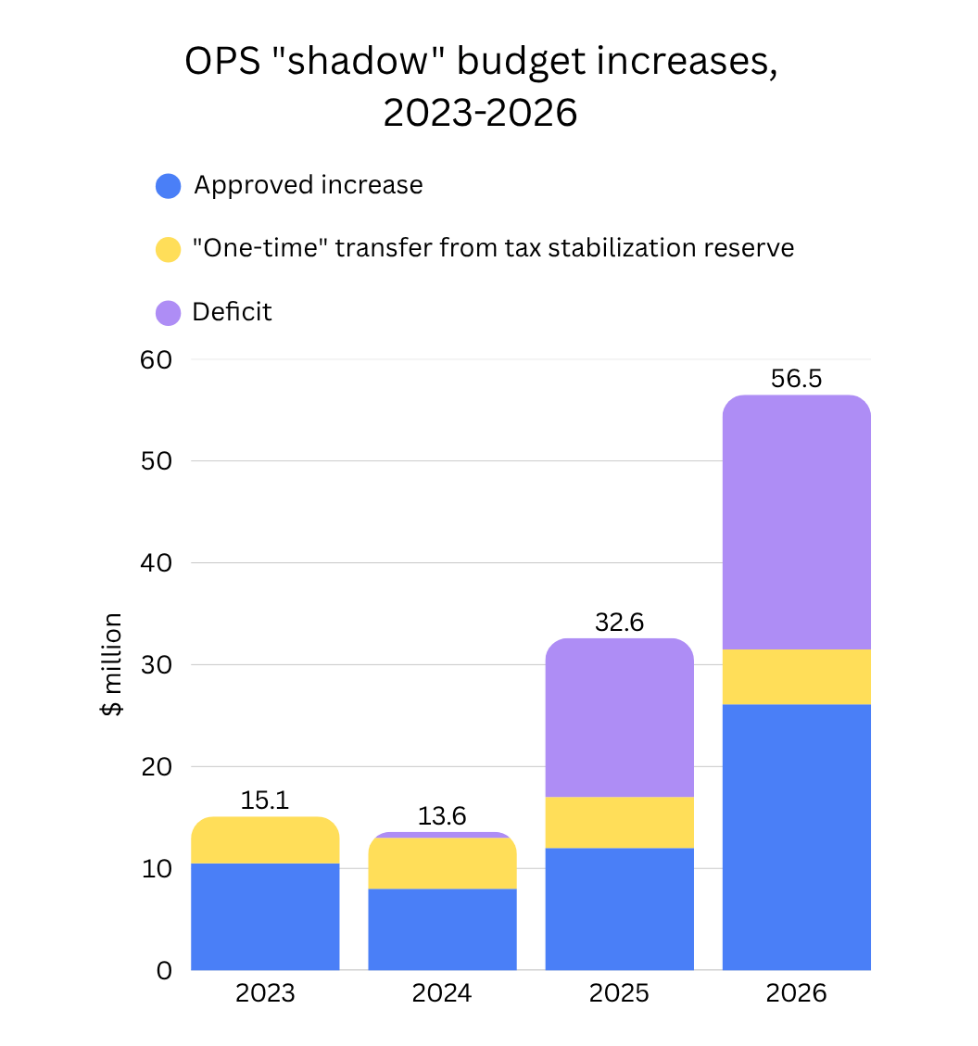
After getting a $31.5 million increase in funding in the 2026 budget, Ottawa Police ServiceOPS is forecasting a $20-25 million deficit in 2026. The Finance and Audit Committee documents for the August 7, 2026 meeting say that Ottawa Police ServiceOPS would be on track for $30 million deficit if it weren't for the $8.5 million in "efficiencies" that they had found. They're also saying that fuel costs are contributing to their deficit, yet last year, when the federal government dropped the price on pollution, OPS said they could recoup the savings. What happened?
From 2023 to 2026, the Ottawa Police ServiceOPS tax-supported budget received a total of $56.6 million in approved increases. On top of that, Ottawa Police ServiceOPS received a total of $20 million in "one-time" transfers from the City of Ottawa tax stabilization reserve (is four straight years of transfers still "one-time"?), and ran a total of $41.2 million of deficits, also paid out of City of Ottawa reserve funds.
During that same four-year period, Ottawa Police ServiceOPS' operating funding would already have totalled $1.4 billion without the $118 million in increases.
Why is Ottawa Police ServiceOPS allowed to run deficits year after year with no consequences? Are there no rules governing the management of public funds? Is anyone at Ottawa Police Service BoardOPSB watching the cookie jar?
It seems that when Ottawa Police Service BoardOPSB and City Council give Ottawa Police ServiceOPS a budget increase, they do so knowing full-well that Ottawa Police ServiceOPS overspent in the past and will likely do so again, leaving a deficit that will be covered from the reserve at the end of the year. That's a budget increase by another name. This means that the OPS budget increase for 2026 will end up being not 8.7%, as approved by Ottawa Police Service BoardOPSB and City Council, but rather 15%. Including the 2025 deficit of $15.6 million, last year's increase was actually 9% rather than the approved 4.3%.
In the minutes of the June 18, 2026 OPSB Finance and Audit Committee meeting, where the City of Ottawa Auditor General provided her report on project management by Ottawa Police ServiceOPS, it was stated that the “Committee referenced the project that went from $600,000 to $2.2 million and asked if there was something the Board should have done. The Executive Director advised that in the current framework there is nothing that requires Board approval as long as the increases are absorbed within the approved overall budget” (emphasis added). Is the sole purpose of Ottawa Police Service BoardOPSB then to increase the Ottawa Police ServiceOPS budget, without conducting any oversight of how that budget is spent?
That same project is now on track to reach a cost of $5.2 million, without Ottawa Police Service BoardOPSB having ever approved an increase to its budget. A project that started at $600,000 will now run to at minimum $5.2 million.
Ottawa Police ServiceOPS ended 2021 with an $8.1 million deficit. As any competent management would do given this financial situation, they instituted a hiring freeze that year. Under a different Ottawa Police Service BoardOPSB leadership, "[t]he 2022 Ottawa Police ServiceOPS Budget included $5.05M in permanent budget base reductions proposed by the Ottawa Police ServiceOPS, as well as an additional $2M brought forward by the Board, for a total of $7.05M (including the elimination of 20 permanent positions)" (Financial Status Report - Fourth Quarter 2022 presented to OPSB on March 27, 2023). Ottawa Police ServiceOPS still got a substantial budget increase in 2022, but that version of Ottawa Police Service BoardOPSB at least called for a modest $2 million in cuts and the elimination of positions. Today's Ottawa Police Service BoardOPSB wouldn't even dream of following their example. Instead, at the City Council budget meeting on December 10, 2025, where the 2026 Ottawa Police ServiceOPS budget passed with little to no critical analysis, councillor and Ottawa Police Service BoardOPSB member Cathy Curry had this to say: “I actually contemplated voting against this police budget... because it's not high enough!”
Clip from Ottawa City Council meeting of December 10, 2025, featuring Councillor Cathy Curry's prudent fiscal management of the Ottawa Police Service budget
While other municipal services are starved of funding and made to find "efficiencies" every year, Ottawa Police Service BoardOPSB and City Council continue to shovel money into the bottomless pit that is the Ottawa Police ServiceOPS budget. As we head towards the municipal election and the 2027 budget season, COPOUT 613 will be watching to see if any elected officials are willing to exercise fiscal responsibility when it comes to Ottawa Police ServiceOPS.
July 27, 2026: OPSB regular meeting
Ottawa Police Service BoardOPSB Board members:
Ottawa Police Service BoardOPSB has decided – on its own initiative, not because of anything mandated by the Community Safety and Policing Act (CSPA) – to hold in camera sessions on various topics. One particular recurring agenda item is “Updates on Demonstrations and Events Management.” This is a broad topic that can cover everything from the Santa Claus parade to Canada Day to protests related to geopolitical events.
The right to protest is protected under the Charter of Rights and Freedoms. The residents of Ottawa have a right to know what the Ottawa Police Service BoardOPSB policy on policing protests is. Section 43(4) of the Community Safety and Policing ActCSPA requires police service boards to "record without note or comment all resolutions, decisions and other proceedings at [a] meeting, whether it is open to the public or not." There may be some operational details that Ottawa Police ServiceOPS would want to keep secret, but that doesn't justify the full discussion, including Ottawa Police Service BoardOPSB members' questions and views, being held in camera with no record of the proceedings available to the public.
At anti-genocide protests over the last 35 months, Ottawa Police ServiceOPS has often shown up with disproportionate numbers. It's not unusual for Ottawa Police ServiceOPS to come with anywhere between 25-35 officers, including 5-10 cruisers, sometimes bicycles, motorcycles and/or drones, to police somewhere between 150-250 people. That works out to approximately 1 cop for every 6-7 protesters. On two occasions in the Fall of 2024, Ontario Provincial PoliceOPP, with the support of the Ottawa Police ServiceOPS, deployed well over 200 cops, along with a drone, an officer with a GoPro camera, and a pre-positioned prisoner transportation vehicle, to police protests. Whose "safety" are they concerned with?
At the Ottawa Police Service BoardOPSB Human Resources committee meeting on July 14, 2026, Chief Stubbs said, in relation to the board's “requirement” that Ottawa Police ServiceOPS reduce overtime by 10% (which he refers to as a “goal”): “Obviously some of the protests and events that we're going to that aren't recoverable, those are something that is a difficult level to manage. But, you know, for argument sake, so do we send 30 officers to that demo, or can we do it with 15? That's where we have to be strategic.”
When is Ottawa Police Service BoardOPSB going to become transparent and open about what it's saying to Ottawa Police ServiceOPS about policing protests? When is Ottawa Police Service BoardOPSB going to hold the police accountable for the resources used to police protests?