Volume 1, Issue 3 (September 2026)

We've seen skyrocketing costs for policing in Ottawa with little to no oversight. We've witnessed cops abuse protesters' rights with little accountability. We've watched OPSB shield itself from the public. We've started COPOUT 613!
COPOUT 613 (Community Oversight of Police Operations to Uphold Transparency) is an Ottawa-based collective dedicated to monitoring and conducting research into policing in Ottawa, focusing on the lack of transparency and accountability from the Ottawa Police Service (OPS), Ottawa Police Service Board (OPSB), and various provincial "oversight" bodies.
In this issue:
Oversight* highlights
Our monthly review of OPSB's "oversight" of OPS
-
In focus
Priority One calls: a reality check
-
Bad apples or rotten barrel... You be the judge!
Our monthly round-up of cops in the news
-
Announcements
This and that
-
Dystopia watch
-
What we're reading
-
Did you know?
-
Dog and pony show
Our monthly antidote to cops being cops!
Oversight* highlights
The noun "oversight" has two very different meanings. Which does OPSB do?
- "watchful and responsible care"
- "an inadvertent omission or error"
Last month's meetings
August 28, 2026: Human Resources Committee Meeting
The only agenda item for this meeting was the presentation of a report on the staffing of the OPSB office. The report outlined the implementation of the staffing strategy in the wake of the Auditor General report finding that OPSB needs more staff. In 2023, OPSB approved the hiring of three new staff members. The five positions were fully staffed by the end of third quarter of 2025.
According to the report, this increase “strengthened the independence, continuity and professionalism of the support available to the Board”. The added staff also, supposedly, allowed them to improve community relationships.
Given the increasing demands of the Community Safety and Policy Act, the report proposes adding two new staff: a Senior Policy and Data Analyst next year and a Quality Assurance and Financial Advisor in 2028.
The committee approved the recommendation.
Theoretically, the Board developing its ability to analyze information coming from OPS would be good news for oversight. In practice, it's clear that this will change nothing in how OPSB operates.
During the meeting, Chief Stubbs was asked for his opinion on the proposal to add new staff. Why does OPS get to comment on how OPSB provides oversight? The Chief was quick to point out that while these positions were a good idea, they would have to be careful not to increase the demands on OPS, because they may not have the resources to respond. Given that OPS has about 358 people working in Corporate Support and 71 people working in the Office of Chief, according to the 2026 budget (pdf, pp. 162-163), you would think they could handle requests from two more OPSB staff!
Committee Chair Henschel agreed that the Board needs to manage the demands it makes on the service. He also stated several times that the Board and the service need to work collaboratively.
Since OPSB view their role as one of collaboration with OPS, it's hard to see how adding two more staff will lead to more robust oversight. Instead, the oversight will have to come from the community!
In focus
Priority One calls: a reality check
We first became interested in how the Ottawa Police Service reports the number of violent crimes after reading John Sewell’s 2021 book Crisis in Canada’s Policing, in which he reports some alarming statistics. He writes:
In Ottawa, in 2019… of 345,800 dispatched calls, only one out of eighty (4,300 out of 345,000) were priority one calls, defined as "when there is an imminent threat to life; actual or potential danger for bodily injury of death; or crimes in progress or imminent." The 1,233 officers with Ottawa police responded to just twelve priority one calls in a typical day in 2019. Unless Ottawa is anomalous, the relative scarcity of priority one calls lends support to the argument that the vast majority of situations police attend to do not involve violence.
Since 2019 was the last pre-Covid year, we decided to delve into more recent statistics to see if those numbers hold true today. The pattern seems somewhat similar; however, a deeper dive shows that they're even worse than what Sewell presented, and that the accuracy of how OPS reports these numbers to the public is troubling and worthy of scrutiny.
Priority One calls in 2024
2024 is the most recent full year of statistics on file. According to OPS, acts of violence and crimes in progress are “Priority One” calls. A crime is generally assigned as Priority One if it is actively in progress or has just occurred with the suspect still on the scene or in the immediate area. Mental health calls can be designated as Priority One if there is an imminent risk of self-harm or suicidal ideation.
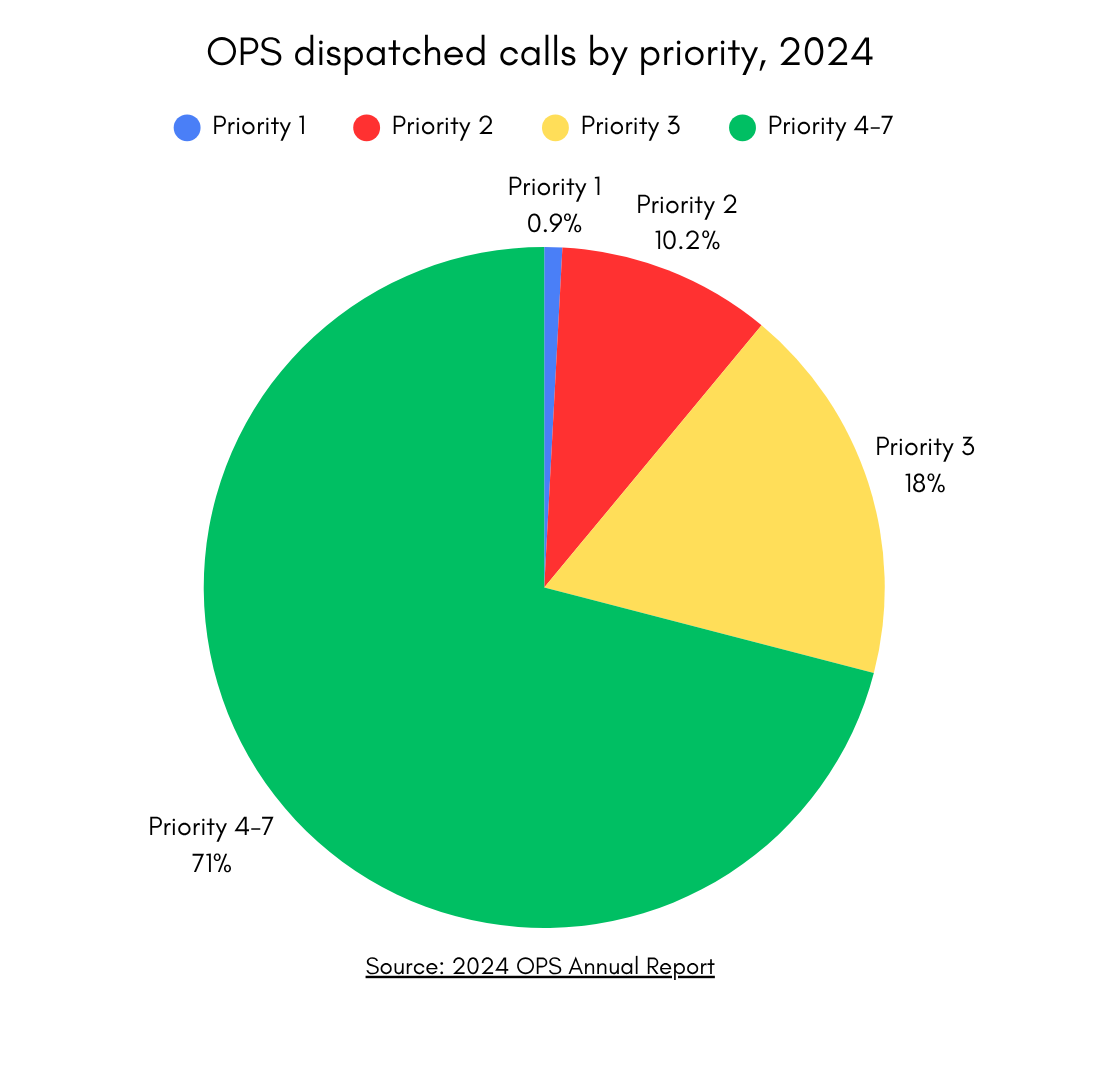
In 2024, OPS received over 378,100 demands for service through both calls for service and online reporting. According to the 2024 annual report, out of 348,486 calls that entered dispatch, 2,962 were Priority One calls (pdf, p. 90). Only 0.9 percent of all calls that entered dispatch were Priority One calls. On average, there were just 8.1 Priority One calls per day to be distributed among 1,600 officers. Compared to 2019, there were 1,339 fewer Priority One calls in 2024, with an additional 367 officers to respond to them. It’s safe to assume that multiple calls are made to report a single Priority One event, thereby inflating the numbers, while some calls that were classified as Priority One calls turn out to be of lesser severity than initially thought.
Most Priority One calls are not crime-related
Furthermore, not only do Priority One calls comprise a negligible number of calls, but even among the small number of Priority One calls, most were not related to violent crime, or even crime in general. In the first quarter of 2024, more than three-quarters (79 percent) of OPS Priority One calls were assisting other emergency services such as Ottawa Fire Service or paramedics (pdf, p. 3). For example, OPS can be called on a Priority One call to assist Ottawa Fire Services by securing a dangerous scene, managing traffic, or handling non-arson fire emergencies where public safety is at immediate risk, but the operational responsibility for firefighting and fire suppression remains with Ottawa Fire Services.
Priority One calls and mental Health
Priority One calls include mental health calls where there is a severe risk of immediate self-harm or suicidal ideation, the individual is actively engaged in a life-threatening act of self-harm, or the individual has access to lethal weapons, such as firearms or knives, and has stated an intent to use them. Priority One calls include serious self-harm attempts which have already occurred and the individual requires immediate medical attention. While there is no denying these calls are of the utmost urgency, they should not be confused with calls related to crime, since the act of suicide is not a crime in Canada.
While OPS reports do not explicitly itemize Priority One mental health calls, the June 23, 2025 submission to the OPS Board states that officers responded to over 12,000 incidents in 2024 which involved a mental health component, including Mental Health Act apprehensions and Community Treatment Order enforcement (pdf, p. 12). OPS acknowledges that there were instances where "physical force" was used, allegedly intended to protect the individual and bystanders. Specifically, out of 33 incidents involving use of force against persons in crisis or barricaded subjects, 17 involved "the application of force, rather than simply its display," including 10 TASER deployments.
During the 2025 budget deliberations, City Council voted to increase funding to OPS through a five percent tax levy on top of the annual increase of 2.9 percent. Community advocates argued that some funds should be redirected to ANCHOR, a program that diverts calls from police by sending trained professionals to attend mental health calls. Some councillors and OPS responded that violent crime had risen across the city and that ANCHOR doesn’t attend calls involving violence. Not a single councillor questioned the claim or asked for actual numbers. The OPS budget was passed by City Council in a vote of 20-5, while the overall budget was passed by 21-4. (In light of OPSB and City Council's failure to ask questions, COPOUT 613 has prepared some questions of our own for candidates in the 2026 municipal election.)
Conclusion
It’s clear that OPS weaponizes fear of violent crime to increase their budget, while councillors use it to fuel their re-election campaigns, notably in rural and suburban wards. Councillors have said their constituents “feel safer” with a greater police presence. OPS and their supporters use broad, aggregate numbers, percentages, and definitions that distort the true statistics of violent crime in Ottawa. There is little scrutiny from Council and the media regarding how these numbers are manipulated to justify massive OPS budget increases, while housing, social services, and health and employment programs remain starved for cash. Sadly, the majority of political candidates in October’s municipal election seem content with maintaining a cycle of policing and punishment, rather than reducing crime through evidence-based prevention programs and social supports.

Bad apples or rotten barrel?
You be the judge!
This is a recurring segment that acts as a round-up of police misdeeds, by everyone from chiefs of police to everyday cops on the beat, covering Ottawa, Ontario, Canada and the rest of the world.
Whenever police misconduct comes to light, we hear that the cops responsible are just "a few bad apples." No one ever seems to remember the full saying: "A few bad apples spoil the whole barrel." If you keep finding bad apples in your barrel, maybe you should throw it out!
Ottawa
August 2026
Ottawa police detective who accessed files on infant deaths handed 2-year demotion. An anti-vaxxer OPS detective accessed police files without authorization in a self-directed "investigation" of infant deaths and the vaccination histories of the infants' mothers. She was found to have engaged in discreditable conduct in March 2025 and last month received a two-year demotion. She does not appear to have shown any remorse for her actions and does not understand how her actions were discreditable. Under the same circumstances would she do it again?
Ontario
August 2026
‘I want justice’: Father demands answers after twins ‘manhandled’ by Toronto police officers at McDonald’s. Two teenagers were assaulted by undercover cops at a MacDonald's. When one tried to defend the other, not knowing that their assailants were cops, they were both arrested for assaulting the officers. Luckily the incident was caught on video and has been widely circulated.
On-duty OPP officer driving drunk 3x legal limit pleads guilty, fined $3,000. An Ontario Provincial Police (OPP) officer pleaded guilty to driving with more than three times the legal limit of alcohol in his system while on duty in a police cruiser. The officer drove to his performance review, but when he entered the meeting room, the other officers could smell the alcohol on his breath, leading them to conduct a breath test and take blood samples. After he sought treatment for addiction and expressed regret for his actions, he was fined $3,000 and received a two-year driving ban.
Canada
September 2026
Canadian Police-Involved Deaths in August 2026. At least 12 people were killed through Canadian police actions in August 2026. This means that Canadian police have killed at least 65 people this year. The Media Co-op has gathered information about police killings in Canada based on police reports, reports from oversight agencies, media reports, and in some cases from families. Since there is no formal mechanism for documenting or reporting police killings, this is likely an undercount.
Manitoba officers charged in just 2% of all police-involved deaths since 2015. Manitoba's police watchdog, Independent Investigation Unit (IIU), is responsible for investigating all officer-involved deaths in Manitoba, but has never met its mandate for accountability, transparency and independence, says a man who helped establish it. The IIU hasn't had a permanent civilian director since 2024, hasn't released annual reports for the past three years, as it's required by law to do, and its website is often inaccessible. How does this allow for accountability and transparency?
American weapons and tech firm Axon has Canadian police in a chokehold. Almost all major police departments in Canada — including OPS — have contracts with the American company Axon. Axon provides police forces with a “one-stop shop” for AI-enabled surveillance tools, such as body-worn cameras, report-writing software, license plate readers, and evidence-management database services. All these tools are interconnected, so each new system a police force buys further entangles them in Axon's web. Axon sponsored this year's conference of the Canadian Association of Police Governance, where police boards from across Canada meet. How do these large purchases of American surveillance tech align with Canada's declaration of “Elbows Up”?
August 2026
Chalk, Cops, and City Hall: A Costly Council Committee Circus. Medicine Hat, Alberta police sent four officers to ticket a grandmother using sidewalk chalk to mark a message of peace on the sidewalk. The woman submitted to the court three instances in which Ottawa police had detained people for writing on the sidewalk with chalk, two of which occurred after the mayor had stated that his "permission" was not required, as police had suggested. The residents of Medicine Hat will surely sleep more soundly now that this chalk-wielding menace has been brought to justice.
Sold a Lie: Emails Reveal Government and College Assured International Students they Would be Eligible for a Post-Graduation Work Permit Despite Rule Changes. International students protesting sudden immigration rule changes faced an ICE-like immigration raid at a protest in Calgary. While the main part of this story is about the Canadian government changing rules on international students in the middle of their studies and the lack of information (lies?) supplied by their schools, we're wondering about the role of Calgary police. CBSA went to the protest stating they received information from various sources “including referrals from law enforcement agencies”. Are police calling for immigration raids on protests? Can this put a chill on the constitutional right to protest? Will other police departments start using this tactic?
July 2026
VPD claimed no emails sent to or from senior cops about compassion club ahead of raid. That’s untrue. When a journalist asked the Vancouver Police Department (VPD) under freedom of information legislation for emails to and from senior VPD officers related to a raid that VPD had conducted, VPD came back with a claim that none existed. However, when a criminal trial started, the court records showed that some of those officers had in fact received emails related to the raid. This story is only the latest example of police viewing freedom of information laws as suggestions that they're free to ignore.
International
August 2026
Florida ‘Deputy of the Year’ Used Flock to Stalk Ex, Held Gun in Her Mouth, Did a Nazi Salute. A Florida deputy sheriff, who was named "Deputy of the Year" by his department in 2025, resigned after an investigation found extreme cases of sexual misconduct, racism, and abuse of police resources, including using Flock to stalk his ex-girlfriend. If this is their best deputy, we wonder what the rest are like.
Tasers, taunts, torment: How 6 White officers subjected 2 Black men to hours of grueling violence, and then tried to cover it up. (Content warning: The story contains graphic descriptions of torture by police.) In January 2026, the chief investigator of the Rankin County Sheriff's Department received a report that "several" Black men were staying at the home of a white woman, and decided that this was justification to raid the house with five other officers. Neither of the two men in the house resisted arrest, but the deputies nevertheless tortured them for two hours, insisting that there were drugs hidden in the house. (No drugs were found.) They shot one of the men in the mouth, then left him bleeding on the floor while they destroyed evidence and planted a BB gun to suggest that they had acted in self-defence. All six cops filed false reports on the incident. What are the odds that this is the first and only time they had done something like this?
July 2026
Exclusive: EU Commission still seeking controversial police agreement with Israel, despite warnings. The European Commission is secretly negotiating a cooperation agreement between Europol, the European Union's police coordination agency, and the State of Israel, despite warnings from their own lawyers that the agreement would violate European Union and international law. Notably, the agreement would allow personal information transferred from Europol to be used in the occupied Palestinian territories and the Syrian Golan Heights “for the prevention, investigation, detection, or prosecution of criminal offences,” in contravention of the EU's official non-recognition of Israeli jurisdiction in those regions. As public opinion around the world becomes increasingly hostile to Israel, police forces — including Canadian ones — are working behind the scenes to tie themselves ever more tightly to it. What does that tell us about the nature of policing?
«Permis de tuer» pour les policiers, la loi validée en urgence à l’Assemblée ("Permission to kill" for police officers — law passed in haste by the National Assembly). The French National Assembly passed a bill instituting a "presumption of legitimacy" when police kill someone, after interior minister Laurent Nuñez made use of an accelerated procedure to curtail debate on it. As Nuñez stated in a TV appearance that day, "Police officers and gendarmes should not be suspected of making use of their weapon illegitimately." While the bill was pushed through by "centrists" aligned with President Macron, this measure had featured in the party program of the far-right Rassemblement National of Marine Le Pen and its predecessor the Front National under her father for decades.
Announcements
Upcoming OPSB meetings
- September 28 , 4:00 pm: Regular meeting (Hybrid; location TBD)
- October 2, 10:00 am: Policy and Governance Committee meeting (Zoom)
- October 9, 10:00 am: Finance and Audit Committee meeting (Zoom)
Other announcements
- September 19, 1:00 pm: HorizonFest (Strathcona Park)
- October 3, (time TBD): Panopti.ca Virtual Town Hall for Canadian Anti-AI Camera Activists (online)
This and that
Dystopia watch
Conducted-energy weapons (CEWs) like Tasers have been part of cops' "less-lethal" (but often still lethal) arsenal for decades. However, they have the unfortunate property (from a cop's perspective) of leaving behind evidence of their use, in the form of marks on the target's skin.
Enter the charmingly-named Compliant Technologies LLC, manufacturer of the "Generated Low Output Voltage Emitter" (GLOVE). Like CEWs, these shock gloves use electricity to produce intense pain in the subject so that a cop can subdue them. Compared to CEWs, though, GLOVEs are "low optic," as the assistant chief of a Missouri police department helpfully explains. Using them "looks better on video, and it looks better to [...] witnesses. With a glove, there are no burn marks or scars.” Other cops praise them for "mitigating liability."
The shock gloves came to public awareness in August, when the Associated Press reported on a proposal to buy $20 million worth of them for Immigration and Customs Enforcement (ICE). With the ICE story drawing attention to the company, residents of Omaha, Nebraska were outraged to learn that school resource officers in their district were carrying shock gloves, and had even used them at the "district's integrated learning center for special education students." All but one of the police forces that operate in Omaha schools agreed to stop carrying the gloves after an August school board meeting where "residents and board members alike said they were appalled at the practice."
How long will it be until OPS catches wind of these new toys?
What we're reading
Defund: Black Lives, Policing, and Safety for All by Sandy Hudson (HarperCollins Publishers, 2025)
Sandy Hudson is a co-founder of the Toronto chapter of Black Lives Matter. In this book, she asks readers to re-think safety as something that doesn't require spending “ever-ballooning resources on a system that fails at harm prevention, perpetuates violence and is inherently discriminatory”. The book provides a good overview of the movement to defund the police, and discusses how so many of us are misinformed on what the police actually do.
Hudson debunks many so-called reforms such as body-worn cameras. She also discusses what is considered a crime. Things like drug use and sex work are heavily policed but corporate crimes such as wage theft are barely acknowledged.
The book provides a good overview of the abolition movement and discusses the necessity of societal transformation that would allow for communal safety without the violence of policing.
Did you know?
Dog and pony show
When pitching the OPS mounted unit in November 2024, Chief Stubbs claimed that "[o]ne horse can equate to 10 to 12 officers." In light of this equivalence, we at COPOUT 613 assume that OPSB will be replacing the 1,600 OPS officers with 134-160 horses.
This recurring segment will explore other non-human animals that could replace cops.
A few weeks ago, a video showing a group of capybaras exploring the legislative assembly building in Mato Grosso, Brazil began circulating. We at COPOUT 613 would like to invite these curious creatures to bring the same inquisitive spirit to the OPSB chambers.